Exotic matter is the name physicists give to matters with weird properties. This weirdness depends on different perspectives of physics. An exotic matter somehow deviates from normal matter and acquires ‘exotic’ properties. A broader definition of exotic matter is any kind of non-baryonic matter—that is not made of baryons, the subatomic particles (such as protons and neutrons) of which ordinary matter is composed. Exotic mass has been considered a colloquial term for matters such as dark matter, negative mass or complex mass.

There are several proposed types of exotic matter:
- Hypothetical particles and states of matter that have “exotic” physical properties that would violate known laws of physics, such as a particle having a negative mass.
- Hypothetical particles and states of matter that have not yet been encountered, but whose properties would be within the realm of mainstream physics if found to exist.
- Several particles whose existence has been experimentally confirmed that are conjectured to be exotic hadrons and within the standard model.
- States of matter that are not commonly encountered, such as Bose-Einstein condensates, fermionic condensates, quantum spin liquids, string net liquid, supercritical fluid, color glass condensate, quark-gluon plasma, Rydberg Matter, Rydberg Polaron and photonic matter but whose properties are entirely within the realm of mainstream physics.
- Forms of matter that are poorly understood, such as dark matter and minor matter.
- Ordinary matter placed under high pressure, which may result in dramatic changes in its physical or chemical properties.
- Degenerate Matter
- Exotic Atoms
ALIEN PLANETS MAYBE MADE OUT OF “EXOTIC MATTER”
Astronomers have identified about a half dozen exoplanets that may be made of an exotic matter known as “strange matter” unknown on Earth.
The atoms that make up conventional matter have nuclei made of protons and neutrons, and protons and neutrons are composed of subatomic particles called quarks. There are six kinds of quarks: up, down, strange, charm, bottom and top. Up and down quarks are the lightest. Each proton contains two up quarks and one down quark, whereas each neutron has two down quarks and one up quark.
Scientists have created strange quarks through powerful collisions in particle accelerators, but these quarks quickly decayed into more stable particles. However, previous research suggested that strange quarks might prove stable within the superdense stellar corpses known as neutron star.
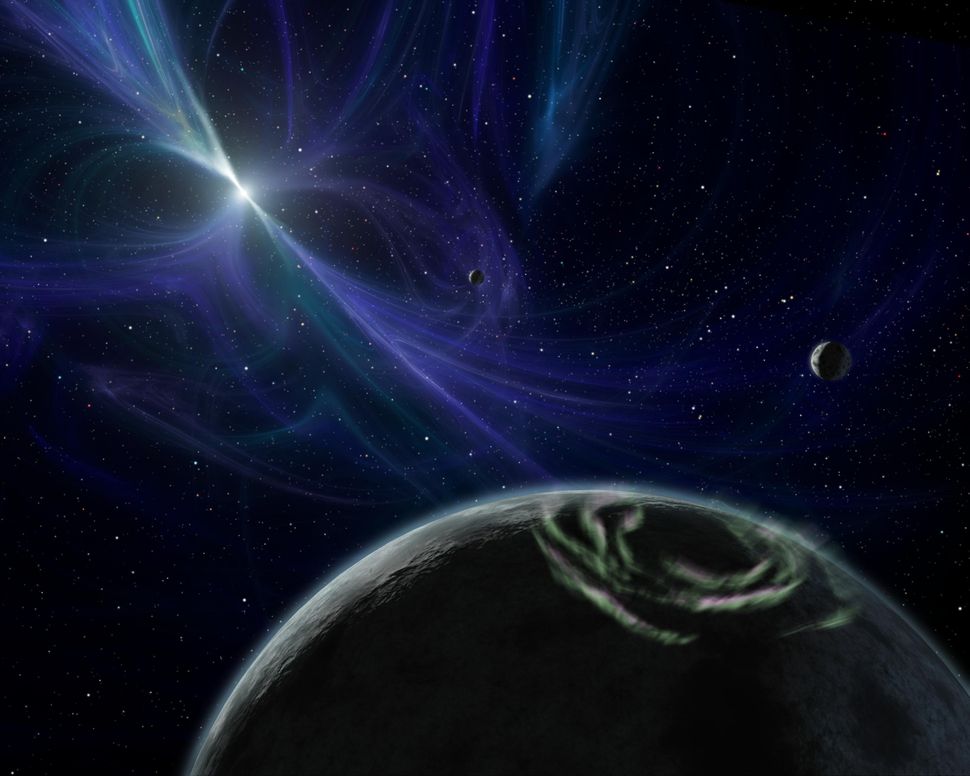
Neutron stars are the remains of large stars that died in cataclysmic explosions known as supernovas, each cramming a mass about 1.3 to 2.5 times that of the sun into a city-size sphere about 12 miles (20 kilometers) across. Their name derives from their exotic composition: The powerful gravitational pull of these remnants crushes protons and electrons together to form neutrons.
In theory, at the extreme pressures found in the cores of especially heavy neutron stars, neutrons might break down into a soup of their component quarks. Prior work suggested that, given enough pressure, half of the neutrons’ down quarks might transform into strange quarks, leading to strange quark stars made of strange matter.
In principle, strange matter should be heavier and more stable than normal matter. Moreover, it might even be capable of converting ordinary matter it encounters into more strange matter. Previous research suggested that a strange quark star that occasionally spurts out strange matter could quickly convert a neutron star orbiting it in a binary system into a strange quark star in just 1 millisecond to 1 second.
Prior work also suggested that neutron stars and strange quark stars should have very similar average densities, said Jin-Jun Geng, an astrophysicist at Nanjing University in China and co-author of the new research that identified exoplanets possibly made of strange matter. This would make it difficult to distinguish them from one another and thus to see if strange quark stars are real.
However, previous research also indicated that planets made of strange matter could exist and that scientists might distinguish these planets from planets made of conventional matter via their densities. Normal planets have densities that are no more than 1,870 lbs. per cubic foot (30 grams per cubic centimeter). In contrast, strange planets would typically have densities of nearly 25 million billion lbs. per cubic foot (400 trillion grams per cubic centimeter), Geng and his colleagues said. (For comparison, gold has a density of about 1,200 lbs. per cubic foot, or nearly 19.3 grams per cubic centimeter.)
“While a strange quark star is very similar to a neutron star, the difference between a strange planet and a normal planet is huge,” Geng told.
The extraordinary density of strange planets means they can survive even if they come within 14.7 miles (23.7 km) of a strange quark star they are orbiting, virtually grazing its surface. In contrast, a normal planet’s orbit can take it only as close as about 348,000 miles (560,000 km) before getting ripped apart by the dead star’s gravitational pull, the researchers said.
Now, based on this feature of these strange worlds, scientists in China say they may have detected four good candidates for strange planets. These exoplanets revolve around pulsars— rapidly spinning neutron stars that appear to flash like lighthouse beacons from our perspective here on Earth — in orbits of about 348,000 miles (560,000 km) or less. The researchers also discovered two other planets that took only slightly longer to complete an orbit and therefore also might also be candidates for strange planets.
Source- Different science based websites
 Science is Life